
HYDRADATA · CS-02 · B2B Sales Pipeline
In your sales meeting, which opportunities need another question?
A planned follow-up date has passed. Did the salesperson follow up? Was the action recorded? Is the date correct?
Portfolio demo | Synthetic data | Not client results
Démonstration de portfolio | Données synthétiques | Aucun résultat client
These three report views help a manager check the records with the opportunity owner, then agree the next action.
Explore the three viewsOne record, one practical question
Check what happened before deciding what to do.
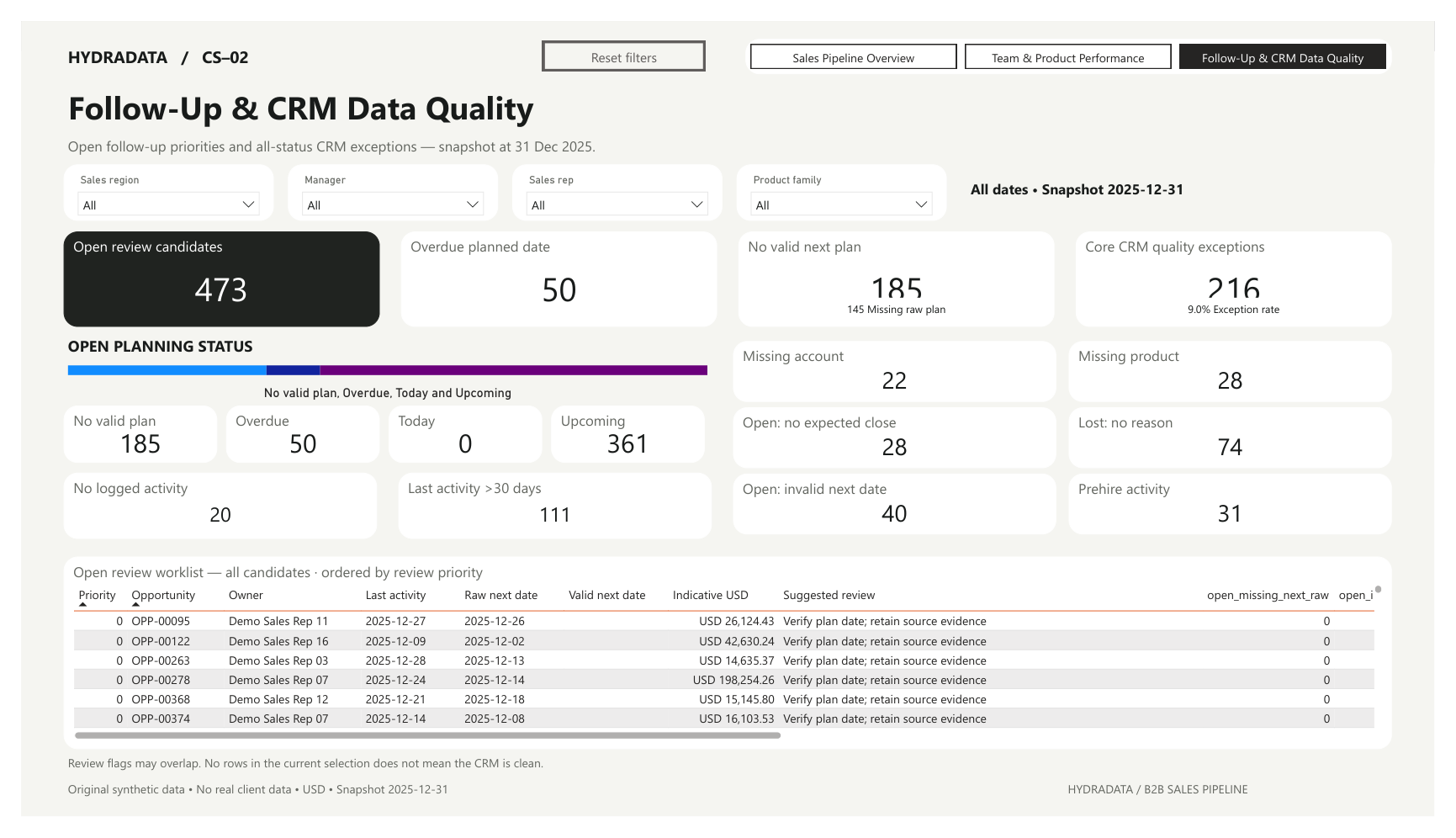
In the third view, opportunity OPP-00095 has an activity dated 27 December 2025, but its next follow-up date is 26 December. The report leaves the valid next date blank and suggests checking the date.
What should the manager ask?
Ask the owner to confirm what happened and whether the dates are correct. Correct the record where needed, then agree the next follow-up. Both may be necessary.
A past date alone does not prove a missed task. An empty activity log does not prove that nothing happened.
Three-page walkthrough
A question for every view.
Static pages exported from Power BI. Pages 1 and 2 select Closed year: 2025; other visible filters are All. Page 3 uses all dates. Open opportunities use a fixed snapshot of 31 December 2025. All amounts are USD.
These captures show the current report revision. Some table columns and tooltips are still being refined; the images show only the visible rows and do not provide live interaction.
Sales Pipeline Overview
Question: Which group of opportunities should the meeting look at more closely?
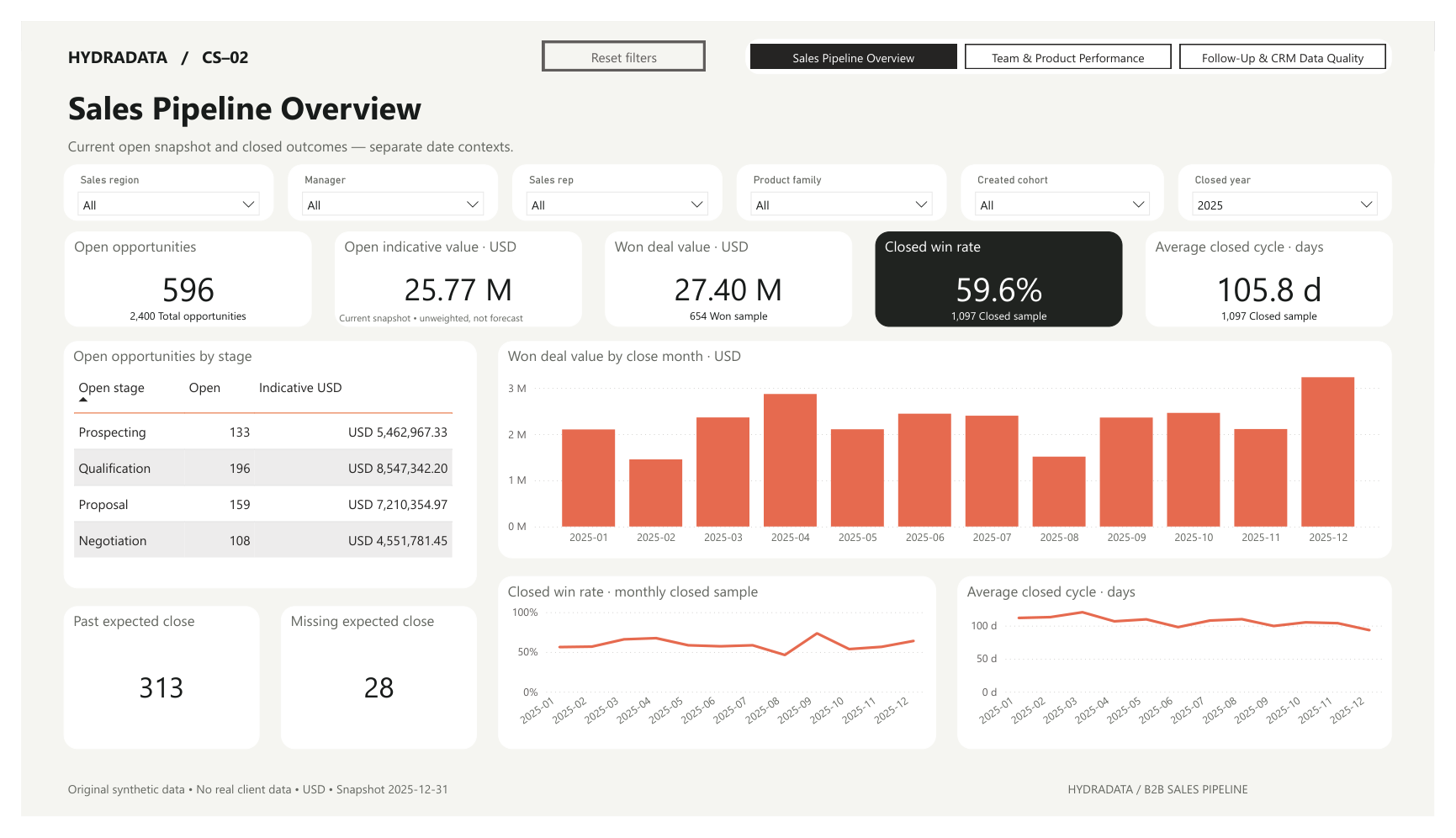
What to notice: Qualification contains 196 open opportunities and USD 8.55M of indicative value, the largest current-stage group in this view. Separately, 313 open opportunities have an expected closing date before the snapshot. That invites a check of the closing plans and supporting activity records.
Next check: Choose a group to discuss with its owners, then check the dates and records. Stage concentration alone does not establish a bottleneck or a failed conversion.
Team & Product Performance
Question: Before discussing differences between salespeople, what context should the manager check?
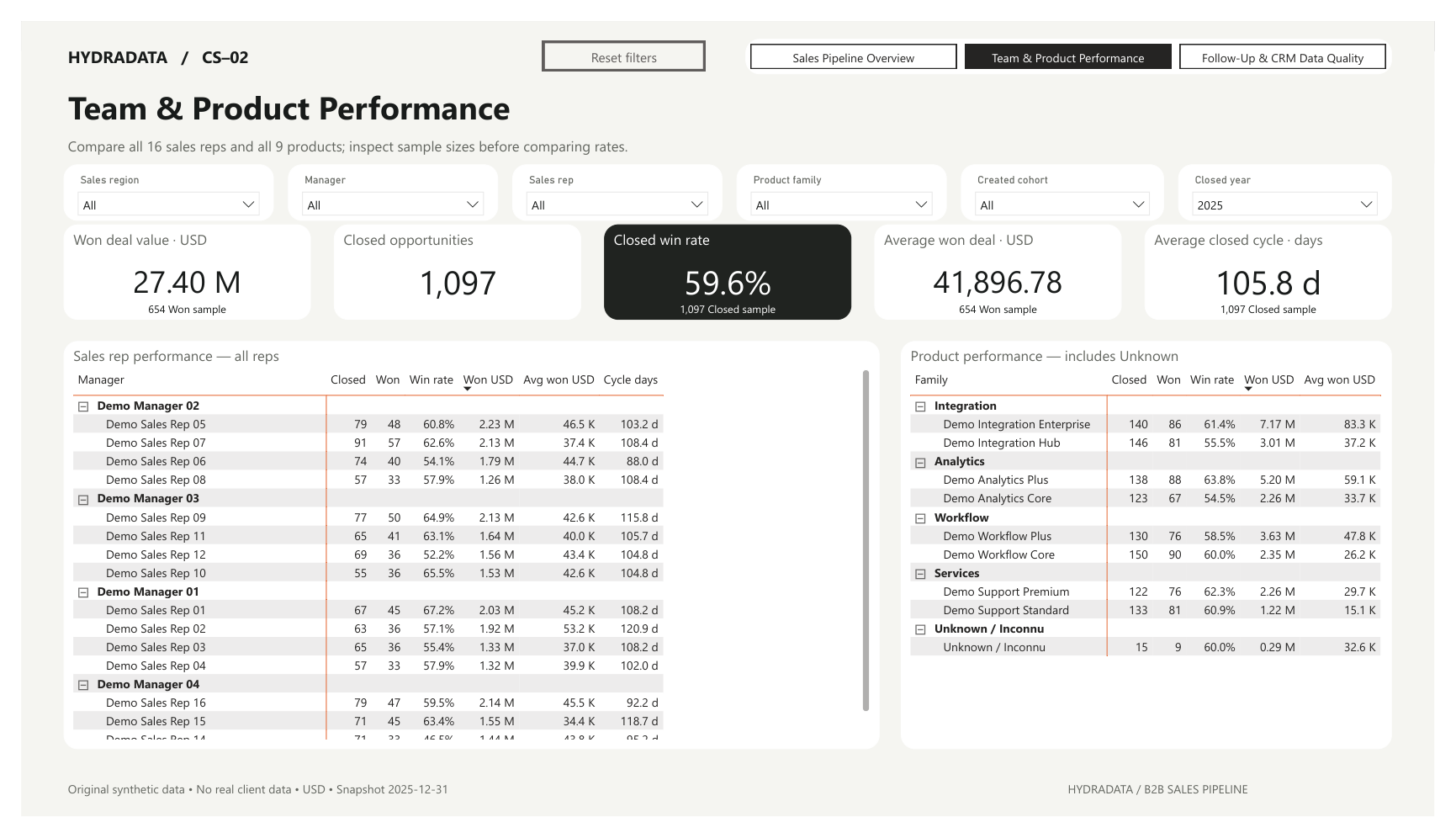
What to notice: In the visible rows, Demo Sales Rep 05 has 48 wins and about USD 2.23M of won value; Demo Sales Rep 07 has 57 wins and about USD 2.13M. The higher total comes with fewer wins. Average won value and product mix are useful next checks.
Next check: Read Closed N and Won N beside the rates and averages. Check the product mix and selected closing period before interpreting differences. Opportunities belong to their current owners; the data does not show ownership history or isolate individual ability.
Follow-Up & CRM Data Quality
Question: Has the follow-up happened, is the record missing, or does the date need checking?
What to notice: Look at the first visible record, OPP-00095. Its latest activity is dated 27 December 2025, but its raw next follow-up date is 26 December. The valid next-date cell is blank and the suggested review asks for a date check. Start by asking the owner to confirm the dates and what happened.
Next check: Confirm whether follow-up occurred and whether the CRM reflects it. Correct a date or add the missing record when justified, then agree the next action. An empty log does not prove no action occurred, and an overdue plan does not prove an unfinished task.
Definitions and limits
Keep the context beside the numbers.
- Open opportunity age measures time since creation, not time without follow-up.
- Current stage distribution is not a historical conversion funnel. A current pipeline snapshot and historical closed-date analysis answer different questions.
- Read Closed N and Won N alongside rates and averages. Current-owner attribution does not establish historical ownership or individual contribution. There is no universal minimum sample threshold here.
- Win rate is won opportunities divided by won plus lost opportunities in the selected close-date context. Average won value is won deal value divided by Won N.
- Average closed cycle covers won and lost opportunities, from creation to actual close in calendar days; same-day closes count as zero. Open opportunities are excluded.
- Quality rules can overlap. Counts across categories must not be added as if they were different opportunities.
- Won deal value is not financially recognised revenue. Open indicative value is not a forecast.
Original synthetic sample
What this case demonstrates.
HYDRADATA created this five-table sample with 9,538 rows and 47 original fields. Its anomalies illustrate a review method; they are not evidence of problems at a real company.
The existing HYDRADATA dataset notice covers released CSV data and accompanying dictionaries under CC BY 4.0. It does not extend that licence to the website, brand, dashboard designs, PBIX or code.
What the evidence can support
This is a portfolio demonstration of how to structure a sales review. It reports no client engagement, revenue uplift, conversion improvement, time savings or ROI.
Weighted pipeline, quota attainment, historical stage conversion and forecasting are outside this case. Fictional companies and contacts must not be used as real sales leads.
Start with your review question
When a planned follow-up date has passed, how do you check what actually happened?
Discuss the records and management questions your sales review needs to support.